

Abstract
Background: In the modern era; the concept of a work life balance has gained widespread academic and practical interest and has been viewed from both a public and the private sector’s perspective. Work life balance is considered important to be certain that the personnel is able to manage a stable work life balance.
Aim: It is to assess the importance of work life balance within the modern business environment
Methods: A quantitative research design has been selected with the SMART PLS being selected for assessing the relationship between the variables. 500 participants are observed within the data collection method and a survey questionnaire was preferred.
Results: A moderate level yet a positive association is observed between the variables from 500 observations. A modest 25% variance is also observed on the dependent variable.
Conclusion: It is concluded that there is a considerable amount of importance attested with the work life balance in the modern business environment. Training and policy implications are recommended to facilitate the employee’s work life balance.
Keywords: Work life balance, motivation, organisation policies, job satisfaction
Introduction
Concept of a work life balance has gained widespread interest in the modern era and has been subjected to various discussion from various perspectives. These perspectives range from the public to the private sector to manage and maintain a stable work life balance. Different dimensions are being probed in this case to deliver a positive work life balance and to accommodate its workforce as much as possible.
According to Marzec and Szczudlińska-Kanoś (2023); work life balance has been observed from a multi-dimensional perspective and to create intrinsic motivation for its workforce. Study also observed that there is a requirement to maintain a manageable work life balance so that the employee is also provided an opportunity to manage its personal commitments as well. These changes are observed within the current period owing to the cultural and social changes.
Šimonová and Šafránková (2015) in its study mentions that the concept of managing work life balance is also highlighted due to the diversity in the workforce. Elaborating further, the workforce in the current period includes significant representation by women as well, thus compelling organisations to acknowledge their caring and domestic responsibilities. Regarding the work life balance; it is still not clear since there is no major definition attested with the concept. But there are attempts to generalize the concept such as by Greenhaus et al. (2003); Brough et al. (2020) that described work life balance as a general approach for achieving job satisfaction. Elaborating further; work life balance is observed when there is a clear priority between an individual’s personal and professional life.
Despite the widespread understanding regarding the concept; there is still a substantial amount of issues present to balance work life. It is because of the lack of understanding and awareness in organisations regarding this concept. Another aspect is that the business makes deliberate attempts to compromise the work life balance by increasing work load and pressure (Syihabudhin et al., 2020). It is also observed in Mathew et al. (2010)’s study conducted in Indian context and observed that there is a decline in work life balance due to excessive targets, curtailing employees’ leaves, and management pressure on its workforce.
In a more recent rendition; Sharma and Jha (2021) also concurs that organisational policies play a significant role in maintaining work life balance. Such policies are considered to have implications on its employees’ motivation and also subsequently on its job satisfaction. The kind of pressure and issues present in these cases are considered to be significant since it compromises on the work life balance and compromises the work atmosphere. One of the main hindrances in this case is the management’s policy that dictates the work life balance’s feasibility. Shakir and Siddiqui (2018)’s study mentions that there are personal commitments attested with each employee that needs to be catered by them. Additional tasks and lack of its scheduling leads to an upset in the work life balance.
Considering the background; the research’s problem identified is that there are multiple perspectives attested with work life balance concept. Perspectives within the public sector and the private sector differs owing to different organisational policies and nature of work. Thus, there is a substantial amount of perspectives that can be viewed concerning with the work life balance but there is paucity of information that specifically focuses on the work life balance. Another problem identified is the lack of understanding regarding the work life’s effect on the job motivation and the effect it has on the modern business environment. There is a lack of specific discussion on the topic that can be ascertained from the fact that there is still a lack of understanding and consensus regarding work life balance’s importance within the modern business environment.
Lack of action and strategies present in the work life balance to accommodate a diverse workforce has also been a challenge for the research. It is because of the lack of focus on the diversity in requirements emerging from the workforce that makes work life balance an important aspect to consider. Social expectations and the lack of regulations concerning with work life balance. According to Hasan et al. (2021); there are critical managerial implications that are considered to be a barrier in maintaining a positive work life balance since it is positively linked with job satisfaction.
Regarding this relationship between the work life balance and the job satisfaction; it is stated that the former has a substantial impact on the job satisfaction since it ensures and assesses the organisational commitment shared by the employee. Lack of balance in the work life is found to be a hindrance in maintaining any positive motivation and engagement with the business. It leads to an increase in the employee turnover rate and thus reduces the organisation’s competitiveness (Susanto et al., 2022). Such a work life balance is being managed and maintained by organisational policies since it helps in regulating the positive work conditions. According to Jawaad et al. (2019); work life balance provision in an organisation is assessed through its association with the workforce and to cater their professional needs. Elaborating further; it is stated that organisational commitment is observed through training provision in company policies.
Such trainings are also used to maintain work life balance since the employee is able to comfortably manage its operations and also its personal commitments. Need to balance its work life is deemed important and an essential element within the organisation to be certain that it retains its workforce for a longer period (Wood et al., 2020). In an event and organisation is not willing to provide any training or amend its policies to accommodate its workforce; there is a strong chance of the workforce developing a negative perception regarding the business. It is directed towards its inability to create a work life balance for its employees and as a result fails to create any intrinsic or extrinsic motivation.
One of the perspectives that is considered while discussing the work life balance is regarding the organisational commitment (Loan, 2020). The author describes that organisational commitment is to be developed and fostered between the organisation and its workforce and is being committed through its policies. Work life balance is considered to be one of the integral components that determines organisational commitments. Such commitments are usually driven by the organisational policies and attitudes towards its employees and thus increases chances for job satisfaction. According to Vuong et al. (2020); organisational commitment has a substantial role in affecting the employee’s performance and it is reflected in their policies. The organisation can create policies that are favoring flexible working hours and also possibilities of providing remote working options.
In a post-pandemic scenario; remote working has been a major concept developed within the business environment; and has been included as an element for maintaining work life balance (Afsin, 2022). The author also assessed the psychological changes induced within the employees due to the COVID-19 and seeks to avail options for remote working opportunities. A novel concept; remote working is considered to be a major benefit to the workforce since it helps in managing their work life balance (Shirmohammadi et al., 2022). Businesses have been promoting and providing remote working options to its employees as a measure to gain a competitive edge over its competitors.
It is observed to be effective since there is a substantial connection developed between the workforce and the management since the latter is able to create a positive perception about its operations. Workforce are also in tune with the work policies and are able to create a remote working possibility since the business is responsible for providing the necessary arrangements to conduct their work (Gifford, 2022). By providing remote work arrangements; the business is able to create value for its workforce since they are providing them the discretion to work in a hybrid model.
Flexibility in jobs and remote working conditions are able to provide substantial benefit to the workforce since they are provided with flexible working schedule that is compatible with the hybrid working conditions. Main benefit achieved from the flexible working conditions is that there is a higher discretion facilitated to the workforce to manage their work as per their requirement (Ferreira et al., 2021). It is considered significant for the organisation because it is able to reduce the work pressure on the workforce and is able to provide some form of autonomy to its employees regarding balancing their work.
By providing such flexible opportunities to the workforce; the business is able to create a positive perception about its business and to ensure that the business is able to improve its performance by gaining competitive edge and ensure that its workforce continue their association with the business (Lonska et al., 2021). It is considered to be effective as remote working opportunities is aligned within the positive work’s role adjustment for the employees. Use of policy discretion allows the workplace to increase their chances of attaining job satisfaction since they find themselves more attuned with the business environment and are more likely to increase their association with the business in the long run. It is also considered to be an indication regarding job satisfaction and a reflection of the management sound practices present for its employees.
Providing such opportunities are beneficial for the organisation since it is perceived that they are creating a work life balance and is able to create a better opportunity for its workforce in the long run (Como et al., 2021). Creating a positive perception about its business by providing such facilities and discretion tends to have a significant impact on the workforce and thus as a result are able to continue the association with the entity.
In light of the background and literature provided above; the main inferences derived for the research’s aim is to assess the importance of work life balance within the modern business environment. Key objectives of this research include assessing the role of work life balance on the employee’s job satisfaction, evaluating the role of organisational policies in maintaining work life balance.
Methods
Study design and setting
Considering the research’s topic and nature; a quantitative research design has been selected to ensure objective findings are observed. This is to be applied and discussed to ascertain the relationship between the variables (Bloomfield and Fisher, 2019). By using a quantitative research design; the study intends to discern the probable association and relationship shared between variables and whether it is addressing the objectives. Using quantitative research design is relevant in the current study since it ensures that the researcher is independent from the research and has not role in this regard.
It signifies that the discussion is purely based on the objectives results observed in the study and its subsequent discussion. Discussion is to assess whether the findings are addressing the study’s objectives and questions or not. Since the topic is observed to be facing paucity of information concerning its specifics; the study is understood to use a total of 500 observations.
Research’s sample size is considerably large to accommodate the study’s objectives and to derive positive results to bridge the knowledge gap. For this purpose; a larger sample size is preferred to ensure that there is a substantial data to compute results from and to derive a specific conclusion (Virdun et al., 2015). An adequate sample size is also deemed necessary for the research is because it provides fresh insights regarding the topic and helps in creating a consensus regarding work life balance within the modern business environment.
Having stated about the sample size; the research employs the use of a convenience sampling method to recruit such a large sample size. Convenient sampling techniques find its application within the current research since it is time feasible and helps in identifying relevant participants without incurring any delay (Majid, 2018). Participant’s profile considered feasible for the study includes managers and middle tier employees that are associated with an organisation. The criterion has been discussed and decided considering the fact that the sample size is able to provide in-depth information regarding management policies for balancing their respective work life balance.
After considering the primary data collection; inputs are to be evaluated on SMART PLS; statistical software used for discerning the relationship between the variables. Based on the results; inferences are to be derived from the observations and subjected to a discussion to ensure the study’s aim and discussion are addressed. PCA, Fixed/Random effects (Hausman effect), and the Preacher Hayes Model is to be applied on the current research to ensure that the identified problem in the research is addressed respectively.
Following is the equation to be used for the SMARTPLS;
JS = β0 + β1FWP + ut, JS= β0 + β1LEQ + ut, JS= β0 + β1MOS + ut
Results and discussion
Path coefficients
Table 1 Path Coefficients
| Company Size | Employee Age | Flexible Working Hours | Industry Type | Job Satisfaction | Organizational Support | Remote Work Opportunities | |
| Company Size | 0.028 | ||||||
| Employee Age | 0.153 | ||||||
| Flexible Working Hours | 0.229 | ||||||
| Industry Type | 0.287 | ||||||
| Job Satisfaction | |||||||
| Organizational Support | 0.034 | ||||||
| Remote Work Opportunities | -0.038 |
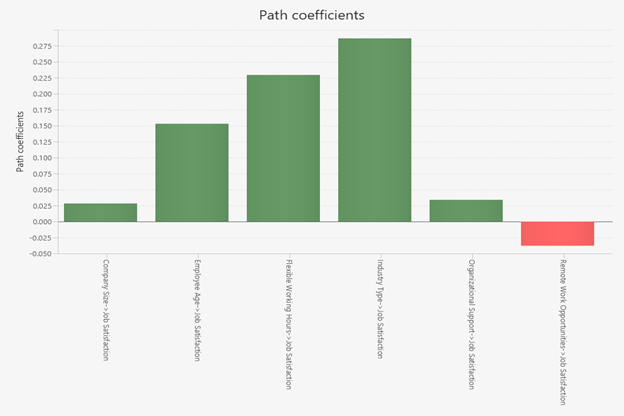
As per the results; it is observed that there is a positive yet a weak correlation between company size and job satisfaction. Represented by its coefficient value of 0.028; it carries the interpretation that an increase in company size leads to a marginal increase in the job satisfaction as well. Regarding the relationship with the second variable i.e. employee age; the relationship is observed to be weak and positive. Its Pearson correlation is 0.153 that shows a weak but better than company size that suggests as seniority increases; satisfaction with job also increases. Similar findings are observed with the flexible working hours; where the pearson correlation value is 0.287 for the industry type and thus it indicates that the type of industry has a moderate level influence on the job satisfaction.
Variable job satisfaction is found to be negatively correlated and a very weak relationship with organisational support and remote working opportunities and suggests that there is a very weak influence on the job satisfaction. After finding the results; the main inferences observed is that the influence of flexible working hours, industry type, and the employee’s age is positively correlated with job satisfaction.
Outer loadings
Table 2 Outer Loadings
| Company Size | Employee Age | Flexible Working Hours | Industry Type | Job Satisfaction | Organizational Support | Remote Work Opportunities | |
| CS1 | 0.690 | ||||||
| CS2 | 0.872 | ||||||
| CS3 | 0.856 | ||||||
| EA1 | 0.765 | ||||||
| EA2 | 0.799 | ||||||
| EA3 | 0.841 | ||||||
| FWH1 | 0.843 | ||||||
| FWH2 | 0.764 | ||||||
| FWH3 | 0.754 | ||||||
| IT1 | 0.570 | ||||||
| IT2 | 0.745 | ||||||
| IT3 | 0.845 | ||||||
| JS1 | 0.917 | ||||||
| JS2 | 0.929 | ||||||
| JS3 | 0.762 | ||||||
| OS1 | 0.859 | ||||||
| OS2 | 0.903 | ||||||
| OS3 | 0.694 | ||||||
| RWO1 | 0.853 | ||||||
| RWO2 | 0.705 | ||||||
| RWO3 | 0.594 |
Above mentioned analysis reveals that the correlation between the various indicators and its latent constructs. Regarding the variable company size; it is observed to share a high correlation since its coefficient values are 0.690, 0.872, and 0.856 and shows that these indicators are deemed reliable attributed to the company size. Similarly, positive and a strong correlation is observed within the employee age’s constructs as its coefficient value includes 0.765, 0.799, and 0.841 respectively. It is also similar for the flexible working hours and job satisfaction as well since its coefficients value with the latent constructs are above 0.75 with each of its constructs.
Considering the findings observed from the outer loadings; the constructs are considered to be effective since it is observed to have a strong and positive latent constructs and are deemed significantly reliable for the current model.
R square
Table 3 R square
| R-square | R-square adjusted | |
| Job Satisfaction | 0.259 | 0.250 |
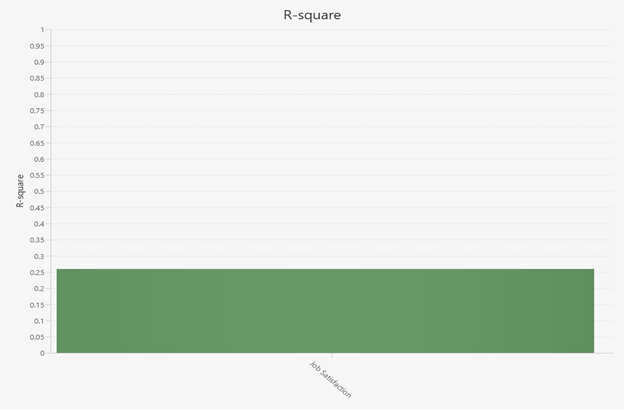
As per the table above; the variance observed in the dependent variable Job Satisfaction can be identified through its R square value, which is 0.259 or 25%. Predictor variables in this case such as company size, flexible working hours, organisational support, and so on are found to have a modest influence on the dependent variable and can be accounted for in the model. A relatively low r square value also shows that there is scope to include more variable and its constructs to better explain the relationship and the variable present on the dependent variable.
Construct reliability and validity
Table 4 Reliability and Validity
| Cronbach’s alpha | Composite reliability (rho_a) | Composite reliability (rho_c) | Average variance extracted (AVE) | |
| Company Size | 0.732 | 0.748 | 0.850 | 0.656 |
| Employee Age | 0.729 | 0.756 | 0.844 | 0.644 |
| Flexible Working Hours | 0.722 | 0.801 | 0.831 | 0.621 |
| Industry Type | 0.553 | 0.604 | 0.769 | 0.532 |
| Job Satisfaction | 0.841 | 0.865 | 0.905 | 0.761 |
| Organizational Support | 0.759 | 0.810 | 0.862 | 0.678 |
| Remote Work Opportunities | 0.578 | 0.657 | 0.765 | 0.526 |
Regarding the reliability and the validity measures; it is observed that all variables demonstrates a moderate to strong levels of internal rate of consistency. There is also a substantial level of convergent validity present in all of the variables with Job satisfaction sharing the highest AVE i.e. 0.761 respectively. Only industry type (0.553) and the remote work opportunities (0.578) have been witnessed with low Cronbach alpha values and thus require a refining in its constructs.
Discriminant validity
Table 5 Discriminant validity
| Company Size | Employee Age | Flexible Working Hours | Industry Type | Job Satisfaction | Organizational Support | Remote Work Opportunities | |
| Company Size | |||||||
| Employee Age | 0.718 | ||||||
| Flexible Working Hours | 0.578 | 0.515 | |||||
| Industry Type | 0.796 | 0.638 | 0.451 | ||||
| Job Satisfaction | 0.407 | 0.430 | 0.412 | 0.593 | |||
| Organizational Support | 0.294 | 0.181 | 0.393 | 0.200 | 0.177 | ||
| Remote Work Opportunities | 0.612 | 0.525 | 0.835 | 0.399 | 0.300 | 0.858 |
Relationships observed in the above table indicates that the constructs remote work opportunities and organisational support are strongly related with the dependent variable i.e. the job satisfaction. On the other hand; organisational support is found to demonstrate a weaker relationship with the dependent variable i.e. 0.2 being the Pearson coefficient. Inferences derived from the relationship can be interpreted that there is a significant interrelationship shared between the variables and there is a substantial impact on the employee’s satisfaction.
Discussion
As per the results; it is observed that the relationship is found to be moderately significant with the dependent variable and there is a need to include additional variables to ascertain its significance. This is also concurring with Gragnano et al. (2020)’s study that observed work family and health balance on the job satisfaction. Specifically including family and health in the results led to better and clear results regarding the topic. The results also indicate that a flexible working opportunities and the remote work possibility is observed to be significant yet share a moderate level association with job satisfaction. It is contrasting with Rodríguez-Sánchez et al. (2020)’s study where time and resources are included as variables to ascertain the relationship and observed a positive and significant relationship.
Its association was also deemed significant and strong in nature and observed that the factor talent retention has a substantial effect on the work life balance and benefits both the organisation and the workforce. Main inferences observed from this finding signifies that there is a substantial amount of variable and constructs that could have been involved to provide a better and in depth understanding regarding work life balance. But, in the current study the results are addressing the formulated objectives since there is a moderate level association and relationship observed between the variables.
In this case; the industry type along with flexible working hours demonstrated a significant amount of relationship with job satisfaction since the relationship was significant and a positive association was observed. This is observed to be consistent with Wöhrmann et al. (2020)’s study as its findings suggested that there is a strong and a positive influence shared by the work life balance and the employee’s job satisfaction. Putranti et al. (2020) in its study observed that the work life balance’s complexity can be addressed through changes within the organisational policies such as facilitating remote working opportunities. Conducted within the COVID-19 context; Putranti et al. (2020)’s findings suggested that the complexities involved in the work life balance can be addressed through the organisation’s efforts in managing its workforce’s work life and to accommodate them with options to operate smoothly.
Implications of this research
Study’s implications are considered to be two tiered in nature i.e. both personal and at the organisational level. The organisational level implications includes assessment regarding retention and recruitment policies in organisations to promote work life balance. This is considered to be a significant and an important consideration that the workforce are provided with relative ease. It is to be provided considering the workforce’s productivity and the overall efficiency and to be certain that they remain their association with the organisation for a longer period.
Secondly; consideration to be given to the organisational culture and its development that promotes remote working opportunities for its workforce. For this purpose, a positive work environment is required to be developed and inculcated within the organisation that is geared towards improving the work life balance in the modern business environment.
Study’s strength and weaknesses
Study’s strength includes discussing and implementing an empirical analysis to ascertain its findings and address the topic. This is considered imperative in providing solid foundations for other studies in a similar topic as well. In this case; the research also discussed about a multifaceted approach by selecting a diverse range of variables to address the study’s objectives.
Regarding its weaknesses; it can be stated that the study observed a series of issues in gaining a strong relationship with its variables and it is evidenced by a relatively modest R square value. This can be attributed to the sample size that needs to be increased so that an elaborate research can be conducted in this regard.
Recommendations
Based on the findings; it is recommended that the policy development is important and an imperative requirement for the organisations to promote work life balance. It includes improving the working hours and to accommodate its workforce with remote working options. Another aspect to consider for recommendation is to improve organisational policies to provide support to its workforce and to incorporate training (Wiradendi Wolor et al., 2020). Leadership training is also required so that the work life balance becomes a permanent feature for such companies and helps in improving its performance in the long run. Organisations are also required to assess the cultural shift in the workforce and to make pertinent policies to accommodate their preferences as well, which can be geared towards work life balance.
Conclusion
In conclusion; it can be stated that the research focused on the work life balance’s concept in the modern business environment. It observed the growing literature regarding work life balance and the importance it holds for the modern business environment. Discussion was also conducted considering the variables flexible working hours, employee wellbeing, job satisfaction, remote working opportunities, and so on.
Article also provided its methodology choice and justified its selection before proceeding with the data analysis techniques. After determining the study’s analysis techniques; it observed a moderate level association and the relationship between the variables were also obtained. Based on the results; discussion was conducted to be certain that it is able to address its formulated objectives or not. Using the material from other literature relevant to the study; it is observed that the research’s findings were in line with other studies and thus the objectives and the question were addressed with relative ease.
References
- Afsin, S.M., 2022. A study on post pandemic psychological changes towards managing work life and reinventing work life balance at Wunderman Thompson.
- Bloomfield, J. and Fisher, M.J., 2019. Quantitative research design. Journal of the Australasian Rehabilitation Nurses Association, 22(2), pp.27-30.
- Brough, P., Timms, C., Chan, X.W., Hawkes, A. and Rasmussen, L., 2020. Work–life balance: Definitions, causes, and consequences. Handbook of socioeconomic determinants of occupational health: From macro-level to micro-level evidence, pp.473-487.
- Como, R., Hambley, L. and Domene, J., 2021. An exploration of work-life wellness and remote work during and beyond COVID-19. Canadian Journal of Career Development, 20(1), pp.46-56.
- Ferreira, R., Pereira, R., Bianchi, I.S. and da Silva, M.M., 2021. Decision factors for remote work adoption: advantages, disadvantages, driving forces and challenges. Journal of Open Innovation: Technology, Market, and Complexity, 7(1), p.70.
- Gifford, J., 2022. Remote working: unprecedented increase and a developing research agenda. Human Resource Development International, 25(2), pp.105-113.
- Gragnano, A., Simbula, S. and Miglioretti, M., 2020. Work–life balance: weighing the importance of work–family and work–health balance. International journal of environmental research and public health, 17(3), p.907.
- Greenhaus, J.H., Collins, K.M. and Shaw, J.D., 2003. The relation between work–family balance and quality of life. Journal of vocational behavior, 63(3), pp.510-531.
- Hasan, T., Jawaad, M. and Butt, I., 2021. The influence of person–job fit, work–life balance, and work conditions on organizational commitment: investigating the mediation of job satisfaction in the private sector of the emerging market. Sustainability, 13(12), p.6622.
- Jawaad, M., Amir, A., Bashir, A. and Hasan, T., 2019. Human resource practices and organizational commitment: The mediating role of job satisfaction in emerging economy. Cogent Business & Management.
- Loan, L.J.M.S.L., 2020. The influence of organizational commitment on employees’ job performance: The mediating role of job satisfaction. Management Science Letters, 10(14), pp.3307-3312.
- Lonska, J., Mietule, I., Litavniece, L., Arbidane, I., Vanadzins, I., Matisane, L. and Paegle, L., 2021. Work–life balance of the employed population during the emergency situation of COVID-19 in Latvia. Frontiers in Psychology, 12, p.682459.
- Majid, U., 2018. Research fundamentals: Study design, population, and sample size. Undergraduate research in natural and clinical science and technology journal, 2, pp.1-7.
- Marzec, M. and Szczudlińska-Kanoś, A., 2023. The importance of work life balance for contemporary management and public policies. European Research Studies, 26(1).
- Mathew, R.V. and Panchanatham, N., 2010. An empirical analysis of the impact of various dimensions of work-life balance on organizational commitment among service sector employees in India. International Journal of Management Studies (IJMS), 17(1), pp.129-147.
- Putranti, H.R.D., Suparmi, S. and Susilo, A., 2020. Work life balance (WLB) complexity and performance of employees during Covid-19 pandemic. Arthatama, 4(1), pp.56-68.
- Rodríguez-Sánchez, J.L., González-Torres, T., Montero-Navarro, A. and Gallego-Losada, R., 2020. Investing time and resources for work–life balance: The effect on talent retention. International journal of environmental research and public health, 17(6), p.1920.
- Shakir, K. and Siddiqui, S.J., 2018. The Relationship Between Work-Life Balance Initiatives and Organizational Citizenship Behavior: The Mediating Role of Perceived Organizational Support. JISR management and social sciences & economics, 16(2), pp.65-84.
- Sharma, E. and Jha, M., 2021. Work-life Balance: A Key to Positive Workplace Attitudes. Indian Journal of Industrial Relations, 57(1).
- Shirmohammadi, M., Au, W.C. and Beigi, M., 2022. Remote work and work-life balance: Lessons learned from the covid-19 pandemic and suggestions for HRD practitioners. Human Resource Development International, 25(2), pp.163-181.
- Šimonová, K. and Šafránková, J., 2015. Work-life balance as rediscovered modern trend in HR management. Social and Economic Revue.
- Susanto, P., Hoque, M.E., Jannat, T., Emely, B., Zona, M.A. and Islam, M.A., 2022. Work-life balance, job satisfaction, and job performance of SMEs employees: The moderating role of family-supportive supervisor behaviors. Frontiers in Psychology, 13, p.906876.
- Syihabudhin, S., Nora, E., Juariyah, L., Hariri, A. and Dhika, O., 2020, August. Effect of workload on employee performance through work life balance at Ollino Garden Hotel Malang East Java. In 3rd Asia Pacific Management Research Conference (APMRC 2019) (pp. 141-146). Atlantis Press.
- Vuong, B.N., Duy Tung, D., Hoa, N.D., Chau, N.T.N. and Tushar, H., 2020. An empirical assessment of organizational commitment and job performance: Vietnam small and medium-sized enterprises. Journal of Asian Finance, Economics and Business, 7(6), pp.277-286.
- Wiradendi Wolor, C., Solikhah, S., Fidhyallah, N.F. and Lestari, D.P., 2020. Effectiveness of e-training, e-leadership, and work life balance on employee performance during COVID-19. Journal of Asian Finance, Economics and Business, 7(10).
- Wöhrmann, A.M., Dilchert, N. and Michel, A., 2020. Working time flexibility and work-life balance. Zeitschrift für Arbeitswissenschaft, 75(1), pp.74-85.
- Wood, J., Oh, J., Park, J. and Kim, W., 2020. The relationship between work engagement and work–life balance in organizations: A review of the empirical research. Human Resource Development Review, 19(3), pp.240-262.