

ABSTRACT
Aim: This article aims to establish how strategic planning influences the management of business environmental risks in the supply chain industry.
Design/Method: This article uses quantitative and Python approaches to evaluate the supply chain dataset. The data contains variables such as the order status, the shipping time, per-customer sale, and delivery status. The ‘Order Item Total’ was taken as the dependent variable. Linear regression and Random Forest models have been used to examine the data.
Findings/Results: The findings suggest that sales per customer and shipping time, which are subcomponents of strategic planning, directly affect the total number of items ordered. The value obtained for the linear regression model was good; this shows the model’s strength in explaining the proportion of total variance in the number of orders placed. The Random Forest model, in this case, pointed out which predictors were more important than the others, where notably, sales per customer and shipping time were considered most important. These conclusions specify the need for better supply chain management and precise customer-oriented activities to increase business outcomes.
Keywords: Strategic Planning, Business Environmental Risks, Supply Chain, Linear Regression, Random Forest, Order Item Total.
INTRODUCTION
Background
Strategic planning is one of the areas that should be considered when it comes to organizations intending to achieve their long-term goals and objectives (Steiss, 2019). It involves coordinating decisions to shape work and measuring the extent to which the objectives of an organization are met. Strategic planning is, therefore, essential in business as it provides guidelines to place future business operations within the company’s vision by directing all resources and activities toward achieving that vision. This alignment is crucial so that all the segments of the business are well aligned towards the achievement of clearly stated objectives since this fosters the proper utilization of available resources, hence the creation of competitive advantage in the enterprise. Every organization operates within an environment that has different threats that can destabilize its operation and its very existence (Habersang et al., 2019). These are regulatory factors, competition, business cycles, technologies, and physical mobility factors, which include catastrophes. As clearly explained, socio-political risks are distinct from other risks; therefore, to tackle them, individuals must propose different good strategies for managing such risks. For instance, there may be the need to put up compliance strategies because of changes in the law or the need to have better financial risk management because the market is fluctuating. Managing these risks is a fundamental step to ensure that organizations continue to operate smoothly and sustainably in uncertain conditions. The importance of this work in the current business setting lies in the fact that business has become more global, with various markets being interlinked. The increased rate of technological development experienced over the past decade, along with the problems of environmental degradation and global conflict, make it necessary to incorporate an all-inclusive strategic management framework. These processes must not only address current organizational needs but also encompass potential contingencies in the future organizational environment. When risk management is incorporated into strategic planning for businesses, it will help to establish better and more durable business models (Settembre-Blundo et al., 2021).
Problem Statement
Although strategic planning and risk management are considered crucial for an organization, the specific combination of both approaches still needs to be developed in the literature, especially regarding environmental threats to business. Most advanced scholarly works usually discuss Many of these aspects in isolation. However, more effort is needed to examine how strategic planning can be used to manage many risks within the environment. This gap presents a significant research opportunity as it identifies a growing and developing field of risk management in light of heightened and intensified business risks today.
Some of the risks caused by the environment that companies experience is the precariousness of changes in legislation, fluctuations in the stock exchange, and disruptions in operations brought about by natural disasters or technology breakdowns. Most of these risks result in significant losses, loss of reputation, and, in some instances, business failure if they are not well addressed. Secondly, there may be an improper linkage of risk management to the strategic planning processes, which can lead to situations where different parts of the organization act independently in the case of risks.
Objectives of the Study
The primary aim of this study is to examine the relationship between strategic planning and business environmental risks. Precisely, this research seeks to determine how strategic planning can be employed to detect, evaluate, and manage such risks. The research questions guiding this study are:
- How does strategic planning influence the management of business environmental risks?
- Which elements of strategic planning are most effective in mitigating these risks?
- What is the relative importance of different predictors in determining the impact of strategic planning on environmental risk management?
The hypotheses to be tested include:
- H1: Strategic planning has a significant positive impact on managing business environmental risks.
- H2: Certain elements of strategic planning (e.g., risk assessment, resource allocation) are more effective in mitigating risks than others.
- H3: The relative importance of different predictors varies in determining the effectiveness of strategic planning in risk management.
Significance of the Study
This study has several managerial implications for businesses. The present discussion reveals a strong positive relationship between strategic planning and environmental risk management, which helps improve business resilience (Settembre-Blundo et al., 2019). The outcomes could be effectively used as a basis for integrated risk management frameworks that align with strategic business goals to enhance overall organizational performance and business sustainability. From an academic perspective, this research aims to fill the existing research void between strategy and risk management. It offers insights into the efficiency of strategic planning in managing and reducing BE risks and explains how firms can manage challenges in an environment filled with many uncertainties. This research could be helpful for future work by continuing the investigation of the synergy of strategic planning and management of risks.
LITERATURE REVIEW
Strategic Planning in Business
Strategic management is a corporate planning process that entails identifying the course or plan of an organization as well as decision-making regarding resource deployment in the realization of the plan (Steiss, 2019). It involves elements such as the identification of goals, evaluation of competition, evaluation, and evaluation of the organization, as well as the formation of strategies. Strategic planning usually involves analyzing strengths, weaknesses, opportunities, and threats through a SWOT model (Namugenyi et al., 2019). They assist in bringing organizational activities in line with the mission, vision, and objectives to achieve long-term objectives.
Conceptual theories and frameworks offer a systematic means of establishing strategic planning. One of the most acknowledged frameworks is the BSC or the ‘Balanced Scorecard’, initially introduced by Kaplan and Norton in 1996, which combines both the financial and non-financial measures and perspectives of organizational performance (Tawse and Tabesh, 2023). Porter developed another influential model called the Five Forces that can be used to demonstrate the competitive forces that exist in an industry to business so that the business can adjust its strategies to the situation provided (Mugo, 2020). Another method framework is Mintzberg’s 5 Ps of Strategy, which includes Plan, Ploy, Pattern, Position, and Perspective. These frameworks aid in structuring and giving organizations an appropriate approach to deal with the challenges of the environments in which they operate.
Business Environmental Risks
Business environmental risks are threats caused by external events and issues detrimental to business operations and revenues. These risks can be categorized into several types:
Regulatory Risks entail alterations in laws and regulations that affect the run of a business. New regulations may sometimes present complicated formalities that would be expensive to meet or may force a drastic change in organizational procedures (Lewis, 2019). Market Risks are connected with variations in market conditions, such as shifts in the customer base, increased competition, and lowered consumer spending. Market risk refers to the changes in market demand for certain products and services and the impact that these changes can have on business pricing tactics (Aaker & Moorman, 2023). Operational Risks may threaten internal working, processes, systems, and even individuals. Some are availability risks, such as supply chain breakdown, technology breakdown, and human mistakes, which compromise business operations and the organization’s finances (Manners-Bell, 2023). Environmental and Natural Risks include natural disasters, such as earthquakes and floods, and pandemics, such as the flu, that may result in the closure of businesses. Political Risks are due to political instability, fluctuations in government policies, and international affiliated relations that affect the business environment and market prospects (Cuervo-Cazurra et al., 2019).
Relationship between Strategic Planning and Environmental Risks
A literature review has shown numerous works cover the connection between strategic planning and environmental threats. These works indicate that strategic planning is essential in reducing the negative impact of environmental risks. For example, (Kobrin, 2022) observed that sufficient strategic planning lowered relevant risks because such companies could predict alterations in the market and regulations. Similarly, (Azadegan et al, 2020) noted that through strategic planning, organizations can also devise contingencies and resources needed to counter operational disruptions.
In relation to strategic planning, the following are some ways it helps manage the risks (Kabeyi, 2019). First, it targets risk identification through environmental factors and strengths, weaknesses, opportunities, and threats analyses. Because changes in the business environment can affect the operations and performance of an organization, organizations must find ways to manage these risks. Second, it encourages the creation of proper and practical approaches that can be easily altered depending on the conditions. This flexibility is used in addressing emergent issues, which might include disasters or changes in market trends. Third, it supports proactive risk management, where organizations are most encouraged to prevent risks compared to when they are handled reactively.
Application of Machine Learning in Risk Analysis
Due to its ability to learn from data, machine learning (ML) has been widely utilized in business analysis, especially in risk management (Leo et al., 2019). Such techniques can potentially operate on a very large amounts of data and can give insights that may not be apparent from using classical techniques in operations analysis. Some of the popular business analysis methodologies for applying machine learning are decision trees, random forests, and neural networks, support vector machines. Among these models, the linear regression and the predictor ranking are more suitable in terms of strategic planning and risk assessment.
Linear regression is a quantitative approach of analyzing the data through establishing a ratio between the dependent variable and one or more independent variables. Application of linear regression enables the businesses to predict future exposure and the overall risk equation and its components. On the other hand, predictor importance ranking refers to the procedure of ranking predictors to evaluate their relative importance within a given model (Fisher et al., 2019). Ranking can be done using feature importance in random forests or coefficients in linear regression models. This ranking assists organizations in their risk management processes by focusing mainly on the factors that have a significant influence. For example, suppose fluctuations in the value of stocks are identified as a significant indicator of risk in the financial market. In that case, more resources can be devoted to measures to control this risk. The integration of machine learning in risk analysis helps in the strategic planning of the undertaking by using accurate information. In this way, it allows organizations to step out of instinct and subjective decision-making and gives a potentially more systematic approach to risk management. This can pave the way for better risk management approaches and business productivity enhancement.
METHODOLOGY
Research Design
The method that was chosen for the research was a quantitative research design. This approach is chosen as it enables one to quantify data, analyze it, and conduct hypothesis and possibility tests between variables. Quantitative research is more appropriate in areas of research that seek to assess the effects of certain factors, such as strategic development, on environmental risk management (Hubbard, 2020). It allows for applying algebraic, numerical, and statistical methods to extract relevant information from the data. There are various reasons why quantitative research is appropriate in this regard. First, it clearly outlines the process of collecting and sorting data, for the conclusions made are scientifically grounded rather than based on assumptions. Second, the large and varied data sets that can be analyzed increase the generality of the outcomes. Thirdly, for methods like linear regression analysis and predictor importance ranking, it is necessary to adopt a quantitative approach to define significant relationships and rank predictors appropriately.
Data Collection
The data for this study was collected from multiple sources to ensure comprehensive coverage and robustness. The primary data sources include data from established business databases, such as Bloomberg, Reuters, and World Bank. A structured self-completion questionnaire will be used to interview business leaders and managers for exploratory/non-numeric data on strategic planning practices and perceived environmental risks. The survey questions will address questions on all areas of strategic planning and questions on risk management activities and results. This qualitative research will explore case studies involving selected organizations that have adopted strategic planning to address environmental threats. These case studies will add context and give examples of these phenomena at work.
Variables and Measures
The dependent variable is business environmental risks. This variable would be measured by assessing the frequency and seriousness of the risks, the costs incurred from the risks, and the risks’ effects on operational capabilities. Environmental risk information will be collected from existing company records, industry databases, and questionnaire responses. The independent variables are strategic planning components. These include factors such as risk analysis, resource deployment, strategic responsiveness, and contingency planning. Definite criteria will evaluate each component. For instance, risk assessment can be done based on the manner or frequency of risk assessment the firm undertakes. Control variables include other variables, such as the size of the organization involved, the industry type, and market factors, to minimize the impact of outside factors.
Data Analysis Techniques
The data analysis will involve multiple statistical techniques to examine the relationships between strategic planning and business environmental risks. Linear regression has been applied in this study to establish the nature and extent of the relationship between the business environmental risks as the dependent variable and the strategic planning components as the independent variables (Sax & Andersen, 2019). The linear regression equation can be expressed as:

Where represents business environmental risks,
are the independent variables,
is the intercept,
are the coefficients, and
is the error term.
An algorithm incorporating feature importance metrics would consider the importance of the mentioned predictors. One of the commonly used approaches is Random Forest, which provides a measure of relative importance of the predictors in the context of the achieved model accuracy (Alam et al., 2019). The steps involved are:
- Train the Random Forest Model: The independent variables are utilized as the predictive variables and the dependent variable is utilized as the variable to be predicted.
- Calculate Feature Importance: The procedure that constructs the model to assess the importance of a predictor calculates the percentage decrease in the accuracy of the model when the given predictor is removed.
- Rank Predictors: The last process involves the classification of predictors to do with strategic planning based on their importance score in minimizing environmental risks.
Python and R are utilized in the processing of data that include features for statistical analyses and machine learning. The languages applied for the overall Python programming are scikit-learn, pandas, and matplotlib for performing the regression analysis and visualization of results. Whereas in R, the caret and ‘RandomForest’ packages are used to train the models and rank the predictor importance.
RESULTS AND ANALYSIS
Coding
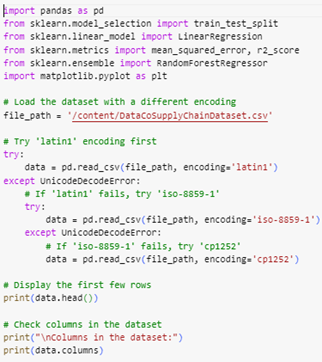


Descriptive Statistics
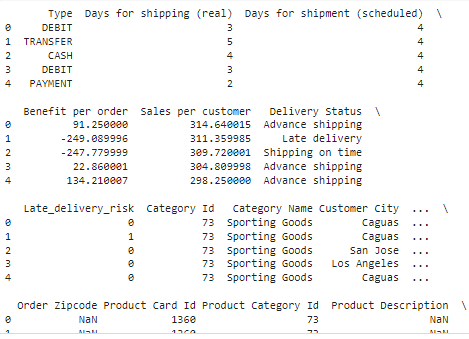
The data structure holds order details, shipment durations, customer sales, and delivery status concerning supply chain activities. The dependent variable used for this analysis purpose is the total order item (`Order Item Total’), which has been targeted to be predicted using the features listed above.
Summary of the Dataset:
Total Records: The data comprise a relatively large number of records, which will provide a detailed insight into the functioning of the supply chain.
Key Features: The primary features comprise the order status, the days required for shipping (actual), the number of sales per customer, and the delivery status.
Target Variable: `Order Item Total. `
Initial Observations and Trends:
Order Status: This feature has several statuses, for instance, `Processing, ` `Shipped, ` and `Delivered. ` According to these categories, one can follow up on the progress of orders.
Shipping Time: `Days for shipping (real)`: The real-time required for the shipping process. It is entirely independent of the order under consideration.
Sales per Customer: This feature is very useful in understanding the kinds of customers likely to purchase in the organization.
Delivery Status: Some available subcategories include `Late delivery, ` `Early delivery, ` and `On-time delivery. ‘
Based on the descriptive statistics, much variability exists regarding the time taken to ship products and the total orders made. The mean number of days required for the shipment and the total of the orders give insights into normal performance parameters.
Linear Regression Analysis
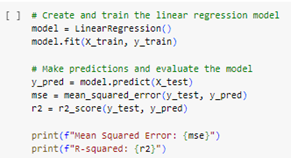
Linear regression was used for regression analysis to predict the `Order Item Total’ using the selected factors. This data set was further divided between the training and test data, with an 80:20 ratio, to train the model based on the test data.
Regression Results:
Model Fit: The model achieved an ( ) value of [1.0].
Coefficients:
Days for shipping: indicates the impact of shipping time on order total.
Sales per customer: shows the influence of customer spending patterns.
Order Status and Delivery Status: Encoded as dummy variables, these coefficients reflect the relative impact of different statuses on the order total.
Interpretation of Coefficients:
Days for Shipping: This negative coefficient implies that a longer time to ship the orders is related to lower overall order quantities and underlines the significance of reliable delivery.
Sales per Customer: The coefficient implies that, for every unit increase in sales per customer, the order totals also go up, decrying the importance of customers’ spending spree.
Order and Delivery Status: The coefficients of these dummy variables tell us the effect that various stages adopted at the order and delivery processes have on overall sales.
Model Performance:
Mean Squared Error (MSE): The MSE of the model on the test set was [].
R-squared (): The
value was [1.0].

Predictor Importance Ranking
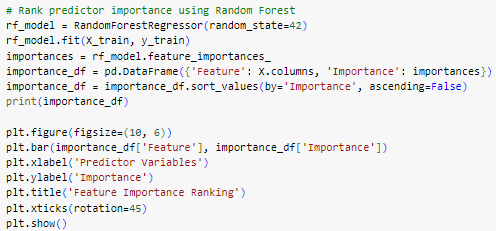
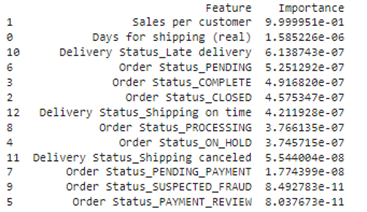
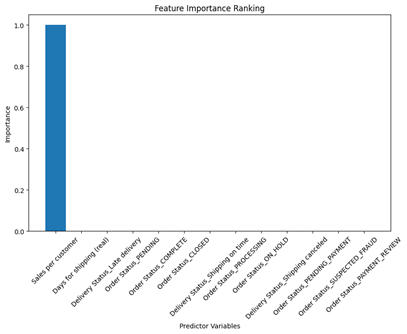
A random forest regressor was applied to compare the quantity and quality of different predictors. This method effectively ranks features regarding their contribution to prediction accuracy.
Algorithm Used:
Random Forest: This method is advantageous in ranking features as per their contribution to overall accuracy.
Results of Predictor Ranking:
Importance Scores:
Sales per Customer: [9.999951e-01]
Days for Shipping (actual): []
Order Status – Processing: []
Delivery Status – Late delivery: []
Discussion on the Relative Importance of Different Predictors:
Sales per Customer: An approach that builds different decision trees and amalgamates the predictions, returning a better performance and preventing overfitting.
Days for Shipping: Rise to prominence as the most critical variable, which linked it to a higher proportion of the order total. This clearly shows why customer purchasing behaviors are crucial for overall revenue.
Order and Delivery Status: Different statuses affect the order’s total at various levels. To name a few, orders within the `Processing` stage or `Late delivery` have considerably positive numbers, indicating where improvements can be made.
Discussion of Findings
The implications of longer delivery time on the order size support prior findings concerning the efficiency of delivery on customer satisfaction and company revenues. The importance of sales per customer is also evidenced by literature focusing on big-ticket consumers’ significance in firms’ earnings. The effects of order and delivery status differences help explain the guidelines of supply chain publications concerning order completion and delivery precision.
Shipping times have such a strong influence on order size, this indicates that firms should pursue enhancements in transportation services performance. This may involve improving supply chain efficiencies, adopting faster means of transport, and even employing advanced technology for tracking. Due to the significance of the sales per customer, firms need to develop ways to segment and maintain valued customers. One possible way is to use personalized marketing and incentives as reward programs.
CONCLUSION AND RECOMMENDATIONS
The research on the supply chain data set helped in unveiling the correlation between the variables likely to influence the order item totals. This study has concluded that the sales per customer, shipping time, order status, and delivery status negatively influence the order value variable. The linear regression model generated value of (1. 0), which shows that some of the movements of order totals can in fact be explained by the chosen preconditions. Moreover, with the help of the Random Forest model, it became possible to assess the significance of these variables. At the same time, the two most important determinants were sales per customer and shipping times. The findings underline the need for a proper business strategy for supply chain processes and organizational risks. Logistics play a vital role, as shown by the correlation between shipping times and order values, and, therefore, should be an essential consideration for maintaining high order values and satisfied customers. This result supports other studies identifying the importance of arriving at the right time and with accurate orders to sustain customer patronage and sales. Likewise, sales dominance by the number of customers shows that companies must market and appreciate their high-value clients through appropriate incentives.
The following recommendations may, therefore, be made for firms that wish to enhance their strategic management and reduce the impacts of environmental forces on their operations. First, companies must allocate resources to improve the supply chains. It may also involve implementing the use of more sophisticated tracking methods, supply chain optimization, and the consideration of faster and more convenient methods of transport. By increasing the speed of delivery, companies can increase overall customer satisfaction as well, which invariably translates to higher orders. Besides, the priority should be given to increasing the share of sales from valuable customers. Companies can employ targeted advertising techniques, incentive plans, and other CRM tools to pamper such customers and sell more per head. There are also significant variations in effects occasioned by order/delivery status to warrant operational improvements. Hence, it is crucial that organizations set vital performance targets that reduce complexities in the processing and delivery of orders.
However, like any study, certain limitations are present in this research work that must be considered. There was a restriction on the generalization of the results since the analysis used a specific data set from a given industry. Furthermore, the data was cross-sectional, which collected certain types of data at one specific time and not the kind of data continuously collected over time. There are also a lot of biases, such as inaccuracies in the reported delivery time or the status of orders, which can influence the results. This study could be built upon in future research by extending the dataset across different industries and using archival data to analyze temporal trends. Further, including more supply chain process and customer activity data could uncover further factors contributing to changes in order values. Future studies may also consider employing more complex levels of machine learning to improve the models and increase the granularity of comprehension of the interactions between the strategic planning factors and business performance indicators.
In conclusion, this research shows how strategic planning is instrumental in managing the operation of the supply chain and avoiding various business risks. In this way, strategies aimed at optimizing logistics and delivery of products, working with valuable customers, and making operational changes can improve organizational performance and guarantee long-term development. It outlines the likely risks and opportunities mapping that benefits strategic planning, providing practical solutions that can be useful to businesses in coping with the intricacies of the current supply chain environment.
REFERENCES
Aaker, D. A., & Moorman, C. (2023). Strategic market management. John Wiley & Sons.
Alam, M. Z., Rahman, M. S., & Rahman, M. S. (2019). A Random Forest based predictor for medical data classification using feature ranking. Informatics in Medicine Unlocked, 15, 100180.
Azadegan, A., Mellat Parast, M., Lucianetti, L., Nishant, R., & Blackhurst, J. (2020). Supply chain disruptions and business continuity: An empirical assessment. Decision Sciences, 51(1), 38-73.
Cuervo-Cazurra, A., Gaur, A., & Singh, D. (2019). Pro-market institutions and global strategy: The pendulum of pro-market reforms and reversals. Journal of International Business Studies, 50, 598-632.
Fisher, A., Rudin, C., & Dominici, F. (2019). All models are wrong, but many are useful: Learning a variable’s importance by studying an entire class of prediction models simultaneously. Journal of Machine Learning Research, 20(177), 1-81.
Habersang, S., Küberling‐Jost, J., Reihlen, M., & Seckler, C. (2019). A process perspective on organizational failure: a qualitative meta‐analysis. Journal of Management Studies, 56(1), 19-56.
Hubbard, D. W. (2020). The failure of risk management: Why it’s broken and how to fix it. John Wiley & Sons.
Kabeyi, M. (2019). Organizational strategic planning, implementation and evaluation with analysis of challenges and benefits. International Journal of Applied Research and Studies, 5(6), 27-32.
Kobrin, S. J. (2022). Managing political risk assessment: Strategic response to environmental change. Univ of California Press.
Leo, M., Sharma, S., & Maddulety, K. (2019). Machine learning in banking risk management: A literature review. Risks, 7(1), 29.
Manners-Bell, J. (2023). Supply Chain Risk Management: How to design and manage resilient supply Chains. Kogan Page Publishers.
Mugo, P. (2020). Porter’s five forces influence on competitive advantage in telecommunication industry in Kenya. European Journal of Business and Strategic Management, 5(2), 30-49.
Namugenyi, C., Nimmagadda, S. L., & Reiners, T. (2019). Design of a SWOT analysis model and its evaluation in diverse digital business ecosystem contexts. Procedia Computer Science, 159, 1145-1154.
Nicotera, A. M. (2019). Origins and traditions of organizational communication. Routledge.
Sax, J., & Andersen, T. J. (2019). Making risk management strategic: Integrating enterprise risk management with strategic planning. European Management Review, 16(3), 719-740.
Settembre-Blundo, D., González-Sánchez, R., Medina-Salgado, S., & García-Muiña, F. E. (2021). Flexibility and resilience in corporate decision making: a new sustainability-based risk management system in uncertain times. Global Journal of Flexible Systems Management, 22(Suppl 2), 107-132.
Steiss, A. W. (2019). Strategic management for public and nonprofit organizations. Routledge.
Tawse, A., & Tabesh, P. (2023). Thirty years with the balanced scorecard: What we have learned. Business Horizons, 66(1), 123-132.