

Abstract
Aims: This study examines how business strategy in the US pharmaceutical industry is affected by customer relationship management (CRM), with a particular emphasis on the role that innovation capabilities play as a moderator.
Method: Using a positivist methodology, the study makes use of primary quantitative data obtained from 250 business experts via an online survey. For data analysis, structural equation modeling, or SEM, is employed.
Results: The results indicate that CRM positively affects corporate strategy, and that this link is mediated by innovation capabilities. The report emphasizes how crucial CRM is to creating successful, long-lasting relationships with customers, which in turn spur innovation and company strategy. The development of focused marketing plans, increased consumer involvement, and greater customer retention are some of the practical ramifications. All things considered, pharmaceutical organizations seeking to boost their competitive edge and boost overall performance through efficient CRM strategies and innovation skills will find great value in the research’s insights.
Introduction
The perception and management of customer relationships by focusing on building relationships and keeping customers is known as customer relationship management. It is a combination of people, processes, and technology that aims to maximize profits by establishing a desired balance between major business investments and customer satisfaction. In the current era of rapidly evolving technology and extremely volatile markets, businesses must strengthen their innovation capabilities to meet customer needs and market demands while preserving a sustainable competitive edge (Anning-Dorson, 2018). According to Teece, (2010) companies who are more innovative in their product and service offerings double their earnings over those that fail to innovate. Given this, it has become crucial for businesses to effectively enhance their innovation capabilities in order to fulfil the needs of highly unpredictable competitive marketplaces. CR focuses on creating, growing, and sustaining fruitful ongoing relationships with specifically chosen customers by leveraging the development and integration of marketing concepts with recently accessible data, technology, and organizational structures.
According to Battor, and Battor, (2010) innovation is essential for organisational success it increase growth, higher sales, profits, and competitive advantage in the market Cui, and Wu, (2016) demonstrated that exceptional performance and innovation go hand in hand. Understanding consumer preferences and needs, obtaining and integrating outside knowledge, and converting it into new and enhanced products are organisational competences for successful production innovation. A key component of this process is successful customer relationship which enables businesses to convert consumer data into relationships by actively utilizing and learning from collected data. Businesses with excellent customer relationships can watch customer behaviour, collect and store consumer knowledge and obtain insights into changing demand, as these innovation capabilities help the businesses to create and develop innovative products and services (Battor, and Battor, 2010).
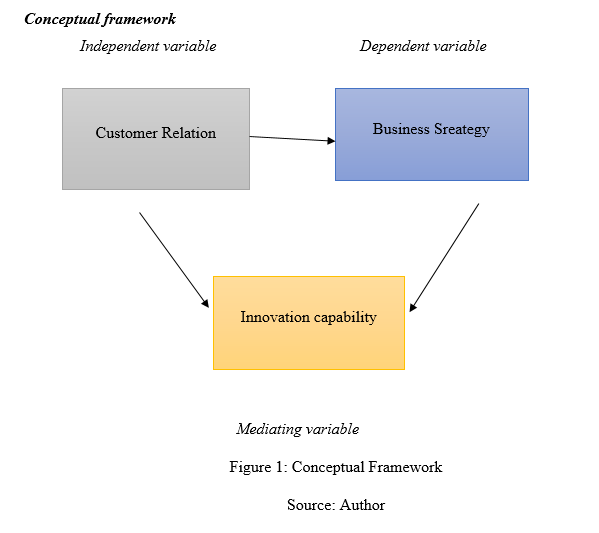
Moreover, there is a gap in the current body of research detailing the precise interactions between customer relationship, innovation capabilities and business in the pharmaceutical namely in the United States, despite the acknowledged significance of innovation and CRM in generating competitive advantage. Pharmaceutical companies looking to improve their competitive position through innovation and efficient customer relationship strategies much understand the relationship. Closing the gap will produce significant insights into how customer relationship drives business strategy much and fosters innovation in the pharmaceutical industry. Therefore, in this case, the following study aims to investigate the impact of customer relationship management on business strategy in the pharmaceutical industry taking into account mediating role of innovation capabilities in the United States. Following are the study’s objectives that:
- To examine the impact of customer relationship on business strategy.
- To investigate the mediating role of innovation capabilities in the relationship between CRM and business strategies with in pharmaceutical companies in the US.
- To identify practical strategies and recommendations for pharmaceutical firms to enhance CRM practices, innovation capabilities, and overall business strategy effectiveness in the competitive US market.
The core research question that the research tries to answer is,
“How does customer relationship market impact the development and execution of business strategies in the pharmaceutical industry in the US, and to what extent is this relationship is mediated by innovation capabilities”
Literature Review
Impact of customer relationship on business strategy
In today’s world, customer relationship management, is a rapidly expanding business technique as Soltani et al. (2018) stated that, it is employed to manage communications between a business and current as well as potential customers. The objective of the CRM approach is to analyze the customer history data with a company. It helps increase sales since it focuses on ways to keep clients. As a results, the business relationship between the company and its customers improves. The findings of the study indicated that, information technology use has a significant impact on CRM effectiveness. Additional factors which have been associated with CMR success include customer orientation, organizational capability and customer knowledge management.
The needs and expectations of consumers are changing, as this CRM has turned into a key instrument for business strategy. Peter and Williams (2016) argued that CRM strategies help firms market their products and services to customers, employees and other stakeholders more profitably and competitively. The study by Modero and Azubike (2016) argued that, CRM is a business strategy used to develop profitable and long-lasting relationships with customers, CRM provides companies a greater understanding of the preferences and tastes of their clients. Scholars and researchers have been amongst those who contributed on empirical studies on the relationship between Customer Relationship Management (CRM) and the success of Businesses. CRM features and performance have been found to positively correlate in a number of studies (Radda et al, 2015; Alawiyah and Humairoh 2017; Madhovi and Dhliwayo 2017).
It is anticipated that every company’s innovation capability is impacted by CRM in an individual manner since organizations show varying degrees of CRM control and development (Lin et al., 2010). Initiatives focused around technology had the most obvious effect among the five categories of innovation. As a consequence, it could be asserted that not every CRM initiatives benefit innovation initiatives. Consequently, it is necessary that other elements, such as supplier data, be included to CRM. The idea that CRM is a significant technological component has also received support from a few research. This outcome reinforces the belief that a company’s ability to innovate improves by strengthening its relationships with customers.
Mediating role of innovation capabilities in the relationship between CRM and business strategies
Innovation capabilities are the outcome of the way a company makes use technology in order to develop innovative systems, policies, software, products, processes, devices, or services. Innovation capabilities of a business in the pharmaceutical industry also include its ability to take in and apply outside data to obtain success-oriented knowledge and business information. According to Lin et al. (2010), various CRM elements have an impact on a business’s capacity to innovate, thus, product innovation, process innovation, administrative innovation, marketing innovation, and service innovation are the four distinct characteristics of CRM that are related to innovative skills. Empirical evidence indicates the association between CRM and a number of behavioral outcomes, even if there are not numerous studies looking at the relationship between CRM and innovation capability as it was intended in the present investigation. In any case, Lin et al. (2010) concluded that CRM can help businesses become more innovative; that long-term CRM partnerships are beneficial for customer involvement, process innovation, and administrative innovation; and that technologically based CRM positively impacts all five types of innovation. Furthermore, learning and market orientation positively impact SMEs’ ability to innovate (Keskin, 2006). According to Lin et al. (2010). innovation capability corresponds to a business’s use of technology in developing new products, services, policies, software, and systems. Innovation capability in various firms relates to the utilization of technology as well as procedures in the creation and promotion of products and services that facilitate the development of robust customer relationships. According to Saunila et al. (2014) indicated that there is a connection between businesses’ performance and its ability to innovative as innovation-capable firms perform between. It was also found that that innovation capabilities acts a mediator in the relationship between market orientation and corporate success.
Theoretical framework
According to Resource Based View Theory, companies using CRM have an opportunity for employing creativity in the context marketing management in order to develop possibilities for ideas from internal or external parties (Colaço, 2015). In strategic management, the theory is popular approach, as it has been extensively utilized as a framework the businesses to identify external resources required by a company to maintain a competitive edge (Taher, 2012). The RBV theory provides an important basis for understanding and predicting the fundamental concepts of a businesses’ competitive advantage and success. It also highlights the value of using skills and abilities to manage a business, recognize competitors, recognize opportunities and be able to do so as a results of entrepreneurial orientation in accordance with the expectations. Such that it helps business actors become more knowledgeable. On the other hand, CRM is seen as a dynamic capability that helps businesses to successfully adapt changes in the business environment by integrating and reconfiguring both internal and external resources (Pedron et al. 2018). The focused placed by the RBV theory on the value of dynamic capabilities in sustaining the competitive advantages over tie in accordance with this. The theory’s emphasis on the strategic importance of internal capabilities is consistent with the mediating functions that innovation capabilities play in the interaction between CRM and business strategy. For pharmaceutical companies, innovation capabilities, like the capacity to create new products and services based on consumer’s insights can provide a steady competitive advantage.
Conceptual framework I
Methodology
The positivist approach has been applied in the current investigation. According to Babones (2016), positivism’s ideology aids in giving data collection and analysis a framework. The author goes on to say that applying a positivist perspective can also aid in reducing the amount of errors found in research findings. In a different study, Babones (2016) shows that the positivist approach relies on gathering and analyzing data in order to draw a useful conclusion. As a result, positivist philosophy helps to ensure that the data collection, analysis, and interpretation steps of the research process are structured in a way that maximizes the study’s overall results. Additionally, it strengthens the data’s legitimacy and authenticity.
The study has adopted primary quantitative as Norris et al. (2015) stated that, primary quantitative is the collection of numerical data as the data collected through wide range of first-hand sources including surreys, interviews, focused groups or observations. The justification of primary quantitative design is that, it makes it possible to collect numerical data for the statistical analysis, providing unbiased and trustworthy insights into the associations between CRM, innovation capabilities and business strategy in the pharmaceutical sector. The researcher tests hypothesis, identify the strength of correlations, patterns and trends in the data by using quantitative approaches. Data was collected through an online survey administered to 250 logged-in users. The purpose of the study is collect quantitative information on the variables including CRM, business strategy and innovation capabilities. Participants were chosen based on their position in their pharmaceutical industry in the US, and their engagement in CRM innovated-capabilities.
The study’s main quantitative approach is the use of SAMRTPLS in which Structural Equal Modelling (SEM) is used. According to Fan et al. (2016) Structural Equation Modelling is a robust, multivariate technique discovered increasingly in scientific examinations in order to test and evaluate multivariate casual relationships. It is a combination of Path Analysis and Confirmatory Factor Analysis (CFA). CFA is currently being used to the measurement model in order to ensure that the variables that have been chosen truly represent the business strategy, innovation capabilities, and CRM underlying structures. As it assists in the validation of study’s measurement tools. In addition, the proposed associations between CRM, innovation capabilities, and Business staretgy are being tested through Path Analysis. Using innovation capabilities as a mediator, the analysis ascertains the direct and indirect effects of SRM on business staretgy in addition to any other possible routes found in the theoretical framework.
Results and Findings
Factor loading, Reliability and Validity
| Factor Loadings | Cronbach’s alpha | Composite reliability (rho_a) | Average variance extracted (AVE) | |
| BS1 | 0.894 | 0.894 | 0.897 | 0.825 |
| BS2 | 0.935 | |||
| BS3 | 0.896 | |||
| CR1 | 0.918 | 0.920 | 0.923 | 0.862 |
| CR2 | 0.926 | |||
| CR3 | 0.942 | |||
| IC1 | 0.878 | 0.735 | 0.760 | 0.659 |
| IC2 | 0.867 | |||
| IC3 | 0.675 |
The factors associated with business strategy(BS), customer relationship management (CR), and innovation capabilities(IC) are listed in the table along with their factor loadings, reliability coefficients (Cronbach’s alpha, composite reliability), and validity (average variance extracted). Every item has strong loadings above 0.6 for factors, meaning that they all make a substantial contribution to their respective structures. this implies that the item assesses business strategy, customer relationship management, and Innovation capabilities at their foundational levels. The reliability coefficients, including Cronbach’s alpha and composite reliability, indicate the internal consistency of the items within each construct.
For business strategy (BS) all three items (BS1, BS2, BS3) show high reliability above 0.89. this suggest that the items are reliable measures of the business strategy construct. similarly, for customer relationship measures of the business strategy construct. Similarly, for customer relationship management (CR) all three items (CR1, CR2, CR3) exhibit high reliability, with Cronbach’s alpha values exceeding 0.92 and composite reliability above 0.92.
This indicates that the times reliability measures the customer relationship management construct. In contrast, the reliability coefficients for innovation capabilities(IC) show slightly lower values. While IC1 and IC2 demonstrate acceptable reliability with Cronbach’s alpha values of 0.735 and 0.867, respectively, IC3 has a lower reliability coefficient (0.675). the composite reliability for IC is also lower compared to BS and CR, indicating that the items related to innovation capabilities may not be as internally consistent as those for business strategy and customer relationship management.
Furthermore, the constructs convergent validity is indicated by the average variance extracted, or AVE. when the items within each construct account for more than 50% of the variance in the construct the AVE values above 0.5 are deemed acceptable, with AVE values exceeding 0.659 for innovation capabilities, 0.825 for business strategy, and 0.862 for customer relationship management, all structures in this table satisfy the convergent validity requirement. In summary, the table’s result indicates that the company strategy and customer relationship management items have excellent reliability and validity, suggesting that they measure their respective constructs accurately. the items pertaining to innovative capacities, on the other hand, have somewhat lower reliability coefficients, indicating that more work may be required to increase these items ‘reliability. In general, the findings bolster the reliability and validity of the measuring methodology employed in the research.
Discriminant Validity
| HTMT Ratio | |
| CR <-> BS | 0.294 |
| IC <-> BS | 0.341 |
| IC <-> CR | 0.393 |
The discriminant validity between the constructs of business strategy(BS), innovation capacities(IC) and customer relationship management (CR) is indicated by the HTMT ratios in the table. it is commonly accepted that discriminant validity is supported by an HTMT ratio less than 0.85 which indicates that the constructs are unique from one another. The two constructs are distinct from one another, as evidenced by the HTMT ratio of 0.294 between CR and BS, which supports their discriminant validity. This implies that the elements assessing company strategy and customer relationship management do not capture the same functional notion.
Furthermore, supporting discriminant validity is the HTMT ratio of 0.341 between IC and BS, which shows that Business strategy and innovation capabilities are conceptually different. this shows that there is no overlap between the innovation capabilities and business strategy. The discriminant validity of these two constructs is supported by the HTMT ratio of 0.393 between IC and BS, which shows that these two constructs are also distinct from one another. This implies assessing innovation capabilities and customer relationship management are not the same. Overall, the results of the HTMT ratios, offer compelling, evidence in favour of the measurement model’s validity is supported by the low ratios between CR and BS, IC and BS and IC and CR, which shows that these variables are conceptually separate from one another.
Model Specification
| R-square | R-square adjusted |
| 0.113 | 0.111 |
| 0.105 | 0.103 |
The model specifications R-square and adjusted R-square values are shown in the table. The degree to which independent variable can account for variations in the dependent variable is shown by the R-square. A more accurate indicator of the model’s goodness of fit is provided by adjusted R-square, which accounts for the number of predictors in the model. The R-square values in this table correspond to 0.113 and 0.105, respectively, although the adjusted R-square values are 0.111 and 0.103. Based on these values, the dependent variable, business strategy, may be explained by the independent variables, customer orientation, organizational capability and customer knowledge management, to the extent that they account for 11.3% and 10.5% of the variation, respectively.
The model appears to explain a small to moderate portion of the variance in company strategy, according to the R-square values. A model’s ability to explain variations is indicated by it is R-square, which ranges from 0.105 to 0.113, where the former represents 11.3% and the latter 10.5% of the variance. The comparatively low Numbers suggest the existence of other elements that impact business Strategy but are not accounted for in the model.
It is expected that when there are numerous predictors in the model, the adjusted R-square values will be slightly lower than R-square values. The model’s goodness of fit is estimated more conservatively by the adjusted R-square values, which penalize over fitting and take into consideration the number of predictors. Overall, the results imply that although some of the variety in business strategy may be explained by the model that incorporates customer orientation, organizational competence, and customer knowledge management, there are probably more factors at play as well. Subsequent investigations may examine supplementary variables that could perhaps enhance the overall comprehension of the elements impacting business strategy within the pharmaceutical sector.
Path Coefficient Analysis
| Original sample | Sample mean | Standard deviation | T statistics | P values | |
| CR -> BS | 0.197 | 0.195 | 0.048 | 4.062 | 0.000 |
| CR -> IC | 0.323 | 0.326 | 0.042 | 7.701 | 0.000 |
| IC -> BS | 0.217 | 0.220 | 0.046 | 4.665 | 0.000 |
The path coefficients, sample mean, standard deviation, T statistics, and P values for the correlations between business strategy (BS), innovation capabilities (IC), and customer relationship management (CR) are displayed in the table as the path coefficient analysis results. Customer relationship management and business strategy have a positive association, as indicated by the path coefficient from CR to BS of 0.197. This implies that corporate strategy improves in tandem with improved customer relationship management techniques. The association is not random, as shown by the T statistic value of 4.062, which is significant at 0.05. Innovativeness is strongly correlated (0.323) with customer relationship management. Improved customer relationship management boosts creativity. A T statistic of 7.701 with 0.05 significance supports the relationship. The route coefficient from IC to BS, 0.217, supports the substantial association between innovation capabilities and business strategy. Thus, innovation improves corporate strategy. The T statistic of 4.665 at 0.05 supports the link’s statistical significance.
Corporate strategy, innovative skills, and pharmaceutical customer relationship management are strongly correlated. Customer relationship management strengthens corporate strategy and innovation skills. Innovation and customer relationship management are crucial to pharmaceutical company strategy, according to this study.
Conclusion and Implications
This study examined the complex relationships between US corporate strategy, innovative pharmaceutical expertise, and CRM. A thorough literature review found that CRM improves customer interactions, which benefits corporate strategy and innovation. Resource-based perspective theory and other theoretical frameworks show that innovation and customer relationship management enhance long-term competitiveness. Quantitative data from online questionnaires supported positivist methods. Data analysis using SMARTPLS and SEM yielded many findings. The measurement approach was valid and reliable for CRM and business strategy variables. Since innovative capacities have lower reliability coefficients, this measure should be evaluated with caution. Discriminant validity tested CRM, innovation, and business strategy, validating the measurement methodology. The model definition research suggested that other factors may affect business strategy, however the model may explain a moderate to modest fraction of business strategy variability. Path coefficient analysis showed strong positive relationships between CRM, company strategy, and innovation. CRM upgrades, corporate strategy, and innovation skills were linked. Innovation and CRM are crucial to pharmaceutical company strategy, as shown by these outcomes. This study enhances knowledge by showing how CRM, innovation, and corporate strategy affect pharmaceutical companies. The findings show that a competitive business needs strong consumer connections and creativity. Further research is needed to uncover pharmaceutical business strategy elements, according to the article.
Implications
This study has major implications for US pharmaceuticals. Understanding how customer relationship management (CRM) affects company strategy may enhance productivity and provide companies an edge. This study can help pharmaceutical businesses customise CRM tactics to client demands. Innovation skills mediate the requirement to integrate CRM with new procedures for corporate performance. This may increase consumer contact, customised marketing, and client retention. CRM data help pharmaceutical businesses locate new markets, improve customer service, and customise products. The findings can also help corporations support innovative and growing industries. This study can help pharmaceutical businesses compete in a fast-changing industry by influencing strategic decision-making.
References
Alawiyah, I. and Humairoh, P.N., 2017. The impact of customer relationship management on company performance in three
Anning-Dorson, T., 2018. Customer involvement capability and service firm performance: The mediating role of innovation. Journal of Business Research, 86, pp.269-280.
Babones, S., 2016. Interpretive quantitative methods for the social sciences. Sociology, 50(3), pp.453-469.
Battor, M. and Battor, M., 2010. The impact of customer relationship management capability on innovation and performance advantages: testing a mediated model. Journal of marketing management, 26(9-10), pp.842-857.
Colaço, M.M.D.S.N.A., 2015. The role of Customer Relationship Management in organizational innovation capability (Doctoral dissertation, Instituto Superior de Economia e Gestão).
Cui, A.S. and Wu, F., 2016. Utilizing customer knowledge in innovation: antecedents and impact of customer involvement on new product performance. Journal of the academy of marketing science, 44, pp.516-538.
Fan, Y., Chen, J., Shirkey, G., John, R., Wu, S.R., Park, H. and Shao, C., 2016. Applications of structural equation modeling (SEM) in ecological studies: an updated review. Ecological Processes, 5, pp.1-12.
Lin, R.J., Chen, R.H. and Kuan‐Shun Chiu, K., 2010. Customer relationship management and innovation capability: an empirical study. industrial Management & data Systems, 110(1), pp.111-133.
Madhovi, P.G. and Dhliwayo, S., 2017. The relationship between customer relationship management (CRM) and performance in the hotel industry. African Journal of Hospitality, Tourism and Leisure, 6(1), pp.1-13.
Norris, J.M., Plonsky, L., Ross, S.J. and Schoonen, R., 2015. Guidelines for reporting quantitative methods and results in primary research. Language Learning, 65(2), pp.470-476.
Omodero, C.O. and Azubike, J.U., 2016. Empirical review of government expenditure on education and economic development in Nigeria (2000–2015). International Journal of Development and Economic Sustainability, 4(5), pp.13-25.
Pedron, C.D., Picoto, W.N., Colaco, M. and Araújo, C.C., 2018. CRM System: The role of dynamic capabilities in creating innovation capability. BBR. Brazilian Business Review, 15, pp.494-511.
Peter, S.S. and William, K., 2016. Role of customer relationship management strategy on competitiveness of commercial banks in Kenya. European journal of business and innovation research, 2(5), pp.68-92.
Radda, A.A., Majidadi, M. and Akanno, S., 2015. Employee engagement: The new model of leadership. Indian Journal of Management Science.
Saunila, M., Pekkola, S. and Ukko, J., 2014. The relationship between innovation capability and performance: The moderating effect of measurement. International Journal of Productivity and Performance Management, 63(2), pp.234-249.
Soltani, Z., Zareie, B., Milani, F.S. and Navimipour, N.J., 2018. The impact of the customer relationship management on the organization performance. The Journal of High Technology Management Research, 29(2), pp.237-246.
Taher, M., 2012. Resource-based view theory. Information Systems Theory: Explaining and Predicting Our Digital Society, Vol. 1, pp.151-163.
Teece, D.J., 2010. Business models, business strategy and innovation. Long range planning, 43(2-3), pp.172-194.